
Holiday Guide for Autistic Kids
Holiday Guide for Autistic Kids
The holiday season can be exciting, but it also brings big changes that may feel overwhelming for autistic children. Routines shift, new people come into their space, travel plans disrupt familiar environments, and sensory experiences become more intense. Even joyful activities, like parties, decorations, and family gatherings, can introduce unpredictability that increases stress and anxiety. Understanding the kinds of challenges your child may face during this time can help you prepare and create a holiday season that feels calmer, more predictable, and more enjoyable for your whole family.
Why are Holidays Difficult for Autistic Kids?
Changes to children’s daily schedule changes
As we get closer to the holidays, schools and after-school programs sometimes change their hours of operation. School days might be shortened, kids might get days off, or teachers might let kids do fun holiday activities during normal class time. All of that means that children will have more unstructured time, which they may find anxiety inducing.
Changes in the people in your home
During the holidays, relatives that autistic children don’t see often might come to visit. Having unfamiliar people in their space may be upsetting, especially if those family members aren’t familiar with your child’s behaviors. Unfamiliar people may disrupt the child’s expected pattern of who belongs in their space. New people also bring social challenges – children might not know how to act around these unfamiliar people and may not know how to communicate with them. If those relatives bring kids along, autistic children may also find themselves confronted with unfamiliar children who want to play, who want to see their things, or who want to go into the autistic child’s safe spaces (bedroom, classroom area, etc…).
Staying at relatives’ houses
Some families might travel to visit out-of-town family members over the holidays. Usually that means long car rides (or airplane rides). It can also mean spending time in an unfamiliar home and sleeping in an unfamiliar room. Autistic kid may also be surrounded by people they do not know well and who have different family patterns than what they are used to. They may not know where to go when they are feeling overwhelmed.
Changes in family time
As the holidays get closer, caregivers might have changes in their schedules. Caregivers may have to spend extra time at work as they get ready for holiday vacations and/or they may have extra things they need to do after work or on the weekends (shopping for presents or special groceries). That can mean a change in the amount of time a caregiver spends and home, which can threaten an autistic child’s sense of routine. In some families, custody of the child is split with an ex-spouse and holidays can represent a change in which parent the child spends time with.
Adults may be more stressed out
Most grown-ups have a long to-do list for the holidays – groceries to buy, packing to do, presents to buy, etc… . Children are often more tuned in to how their caregivers are feeling than the caregivers may realize, which can give children second-hand stress.
Holiday social rules
Holidays come with certain social rules. Things like: wait until it’s your turn to open presents, read the card first, be polite even if you don’t like your gifts, don’t say anything if you don’t like the food someone brought. Autistic kids often struggle with ‘reading the room’ and sometimes struggle with impulse control. Those challenges can make it difficult to know what to say to relatives and/or to wait for things they’re excited about.
New sensations
For most people, part of the fun of the holidays is making special foods, putting up decorations, and wearing special clothes. However, autistic people often have sensory processing challenges that can make unexpected sights, smells, and tastes upsetting.
How can you help your family get ready for the holidays?
Create visual aids
Many of the issues that arise over the holidays boil down to a lack of predictability for your child. You can help by creating visual aids to help your child keep track of what is doing on. You can also follow a few tips and tricks to add some routine to your child’s holidays:
- Create daily visual schedules. Create a schedule that outlines the activities that the child will do each day and display it in a prominent place. Make sure you talk about the schedule so that your child knows to look at it. Make sure to include details like: when you’re leaving for relative’s houses, when relatives will show up at your house, when you’re coming home/when relatives will leave, religious services, mealtimes, special activities, when bedtime is, which days holidays fall on, when special meals will happen, when they’ll open presents, etc . . .. Daily schedules will give structure to your child’s day and help them prepare for new people and events.
- Maintain as much of you child’s normal schedule as possible. For example, try to have mealtimes when you normally have them and try to keep bedtime routines the same.
- Let your child cross off events when they happen. Crossing off events will help your child keep track of time.
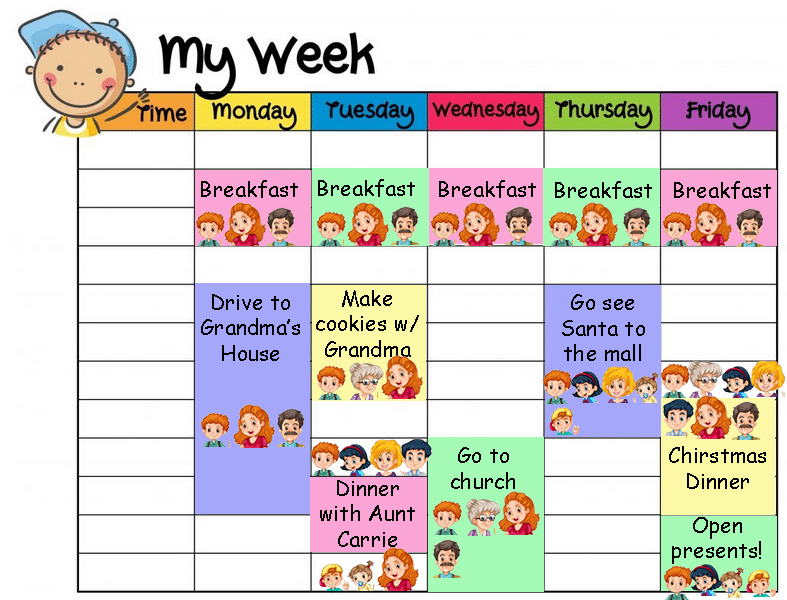
- Create a ‘people locator.’ Holidays can bring a lot of unfamiliar people into your child’s space. Consider making a people locator! A people locator is a calendar that includes the people who will be with the child during different activities. For example, if a child has a daily schedule where they eat breakfast in the dining room at 8am and is going to make Christmas cookies at 10am, you could add details about who will be there with them – consider using pictures of the people who will be there. Please see the example below!
Create a travel kit
Travel can be especially taxing for autistic kids. They may not handle long car rides well and they may struggle in unfamiliar places. One thing you can do to help is put together a bag with things that can help your child feel more relaxed.
- Items for the travel kit: Bring some of your child’s favorite toys, weighted vests or blankets, low-fi music, scents, your child’s favorite food, tablet devices (etc…). Include anything that will help your child relax.
- A travel itinerary: Having something that lists out when you’re leaving, how long the trip will take, and when you’re going to stop off for breaks can help anxious travelers.
- Prepare your child for new places: Talk to them about where you all are going and show them pictures of where they are going to be staying. For example, you could show your child pictures of their grandparent’s house, or you could show them pictures of hotel rooms you’re going to stay in.
Talk to your child about the changes that are going to happen over the holidays
With all the changes that happen around the holidays, your child will be looking to you for guidance. Talking to your child directly about some of the changes that are going to be happening can ease a lot of their anxiety.
- List out all the things that are going to change: If there are changes to a child’s school or after school schedule, tell your child which days they will have off and what they will be doing instead of school.
- Show your child any visual aids you created: Make sure your child knows about the tools that are available to help them keep track of their new schedule.
- If your child has relatives that they do not see often, use pictures to explain who those relatives are and how they are related. For example, “This is your Uncle Joe (show picture). He is my brother and your uncle. He is also your cousin Riley’s dad.”
- Talk your child through what will happen during the holidays and use tools to help them understand what is expected of them: Social Stories are a great way for children to learn about what to do during certain holiday events (like opening presents or going to a religious service). If you search online, you will find lots of written and video holiday social stories for your child – everything from what happens during Christmas to what to do when its time to open presents!
- Practice doing certain things with your child: If you know your child is going to struggle with certain aspects of the holidays, practice what to do! For example, practice saying hello to unfamiliar relatives, practice asking for food at the dinner table, practice what to do if a relative offers them something, etc . . ..
Schedule downtime
One of the best things you can do to keep your child from becoming overwhelmed is to schedule regular periods of quiet time – include these breaks in your child’s schedule and don’t wait until your child is having a crisis to do them. If you’re not at home over the holidays, think about where downtime could happen (a room in a relative’s house, in your car, you could go for a walk with your child, etc…). These breaks will help your child process everything that is happening around them and they will keep you relaxed.
Talk to relatives about your child’s needs
Relatives who don’t visit often might not know much about autism or your child’s needs. As such, it might help the holidays go more smoothly if you talk to them about how your child might behave and what those behaviors mean.
- Educational materials: If you think your relatives would be open it, offer to send them books, podcasts, or online articles about autism.
- Pre-holiday chats: It might be helpful to find some time to schedule a family virtual call or talk to different family members individually about what to expect from your child. Family members may be more understanding of your child’s behaviors is they know what to expect.
- Clearly explain your child’s needs and what “works” for your child: You may need to be explicit with family members about the types of things that your child will find overwhelming or upsetting. Talk to them about things you and your child do to stay calm and talk to them about the sorts of things your child will struggle with. For example, if your child is comfortable playing on their tablet, telling them that they have to go play with the other kids might not go over well. Also, giving your family members some tips on how to communicate with your child will help everyone get to know more about each other.
- Talk to family members about food: Many autistic children have strong food preferences which could become an issue over the holidays. As a caregiver, you may need to bring along specific foods for your child, and your child might refuse to each certain holiday foods. It might help to talk to family members about why you are bringing your own food, remind them not to eat that food themselves, and to ask people not to be offended if your child doesn’t want to eat a dish that they have made.
- Advocate for your child: If a family member is putting your child in an overwhelming environment, reminder them of what your child’s needs are.
With so much going on, it’s no surprise that the holidays can feel overwhelming for autistic children and their families. But with preparation, clear communication, and thoughtful support, you can create a holiday season that feels more predictable and manageable. By building routines into each day and helping your child understand what to expect you’ll give them the tools that they need in order to feel safe and comfortable. Most importantly, remember that it’s okay to adjust traditions or set boundaries so your child can enjoy the holidays in a way that works for them. With planning and compassion, your family can make space for both joy and calm during this busy time of year.
Article By: The Autism Toolkit
References
“Parents Place: Making the Holidays Bright!” Florida State University Center for Autism and Related Disabilities. https://fsucard.com/events/parents-place-making-the-holidays-bright-2025-11/
“Creating an Autism-Friendly Holiday: Strategies for a Joyful Season” The Autism Society. https://autismsociety.org/creating-an-autism-friendly-holiday-strategies-for-a-joyful-season/
“24 Ways to Make the Holidays Kid-Friendly” The Child Mind Institute. https://childmind.org/article/how-to-make-holidays-kid-friendly/
Other resources you may be interested in
Please enjoy our articles and contact us if there’s a topic you would like more information about.