• Women on the Spectrum Social Support Group

    Recurring

    Spectrum has partnered with Emory School of Nursing in starting a Women Only Group for women ages 18 and up with HFA/Asperger's, focusing on sharing challenges and successes of transition, supporting one another, and building friendships for success. This group meets twice monthly via Zoom, first and 3rd Fridays. Contact Dr. Susan Brasher to be added to the email notification list and for an invitation to join the private FaceBook page (Emory PCORI Young Women on the Autism Spectrum Group) susan.n.brasher@emory.edu

    RSVP for the Women Only monthly virtual meeting. Meetings are held the 1st and 3rd Friday of each month, 5-6 pm.

  • Support Group for Families of Autistic Adults

    This group meets one Sunday a month and is for parents, family members, and friends of Autistic individuals. Guest speakers are hosted every other month

    Free
  • Support Group for Women (50+)

    Join us monthly for an support group that offers Autistic women, age 50+ an opportunity to come together to explore issues such as:

    Receiving a diagnosis later in life
    Masking and Camouflaging
    Finding Support; Building and Maintaining Relationships
    Challenges Post Menopause; Decline of Executive Functioning
    Mid-Life Identity
    Managing Stress and Coping Strategies
    Self-Care

    $10
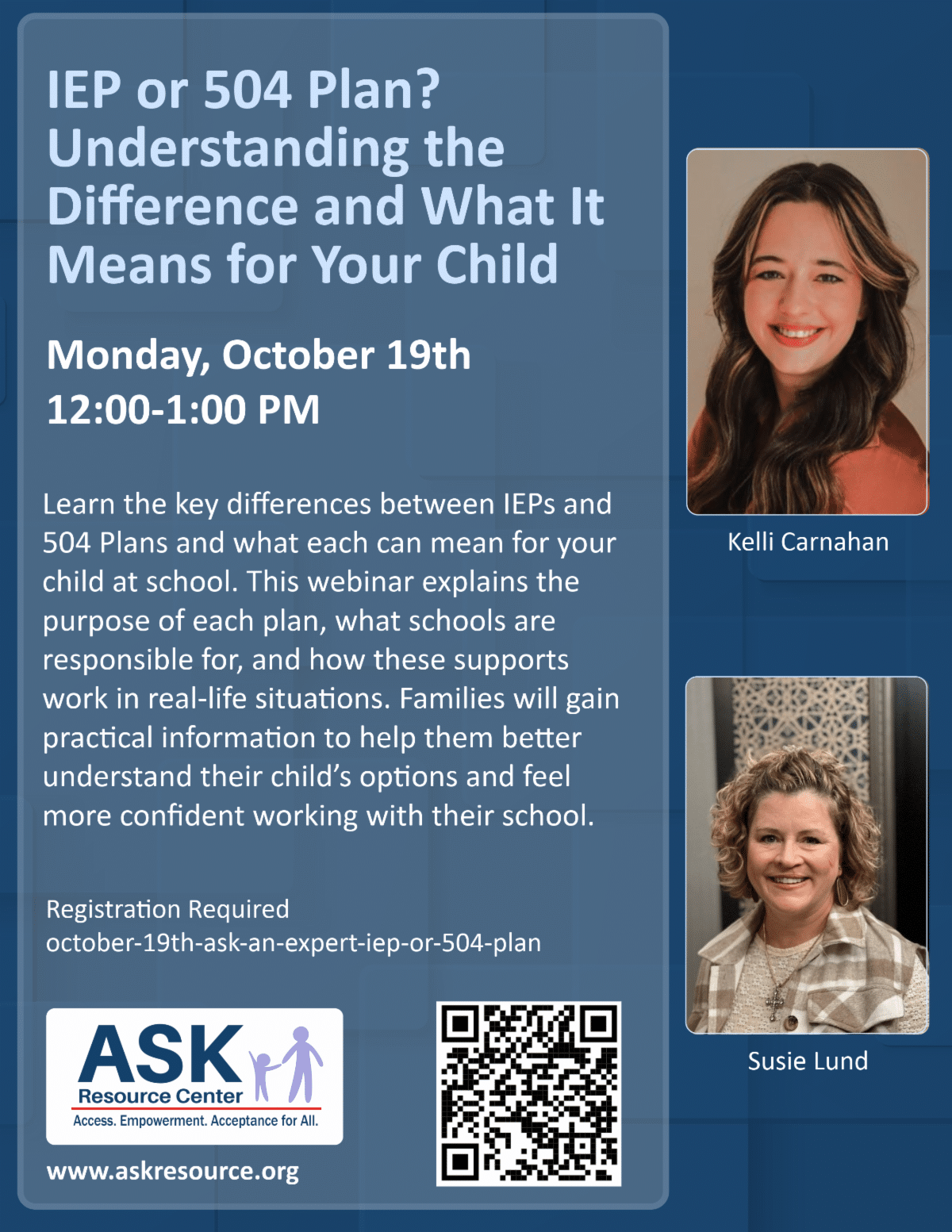
  • IEP or 504 Plan? Understanding the Difference and What It Means for Your Child

    Learn the key differences between IEPs and 504 Plans and what each can mean for your child at school. This webinar explains the purpose of each plan, what schools are responsible for, and how these supports work in real-life situations. Families will gain practical information to help them better understand their child’s options and feel more confident working with their school.

    Free
  • Workshop – Introduction to Autism for Adults

    A presentation and discussion for Autistic adults to come and explore their understanding of autism through a neurological lens. We will discuss common misconceptions, the Autistic identity, and common Autistic traits, strengths, and challenges. This presentation is given by an Autistic adult and a Neurodivergent ally. You might enjoy this presentation and discussion if you are newly diagnosed, considering whether you may be autistic, or if you have only explored autism through a deficit lens in the past.

    Free
  • Workshop – Autism and the IEP for Caregivers of Autistic Children/Teens/Young Adults (through age 22)

    Join AANE for a 90-minute workshop with Q&A for parents and guardians on the ins and outs of Individualized Education Programs (IEPs) for autistic students. Learn what our staff look for when conducting IEP reviews. This workshop is not state specific. Topics include::

    Autism-specific considerations for the parent input statement
    Evaluations
    Accommodations
    SMART goals
    Services
    Post-secondary transition planning

    Free
  • Tool Time Tuesdays

    Recurring

    10/6/26: Easterseals Port Health, World Cerebral Palsy Day! - Easterseals PORT Health (ESPH) is honored to share how our programs and services support children, adults and families with cerebral palsy and other developmental disabilities.

    As an affiliate of United Cerebral Palsy (UCP), ESPH is committed to promoting independence, inclusion and opportunities for individuals with cerebral palsy and developmental disabilities to live, learn, work and thrive in their communities. Presented by Holly Connor, Family Navigator Supervisor ICS

    10/13/26: Progress Notes - Ever get a progress note and wonder, “Okay… but what does this actually tell me?” Please join us as we discuss what to look for in progress notes and how data can help you better understand your child’s progress toward their IEP goals. Presented by Anastacia Newton, Parent Educator

    10/20/26: Virtual IEP Meetings - Virtual IEP meetings are occurring more and more frequently. In this webinar, we will explore how to navigate virtual meetings while still maintaining communication and collaboration. Join us for some tips and tricks as well as supporting resources. Presented by Anastacia Newton, Parent Educator

    10/27/26: Artificial Intelligence - Presented by Anne Johnston, Parent Educator

    Free
  • Multi-Session Support Group for Adults

    A closed support group has the same group members (up to 12) for a set number of sessions (8). Closed support groups are ideal for adults who are looking for deeper connections and more extensive peer support from group members. For the best support group experience, closed group members should plan on attending all 8 meetings in the series. This group offers a safe environment where Autistic adults can talk with like-minded people, share issues and concerns, and celebrate successes. Common topics include: disclosure, self-advocacy, and relationships.

    $100
  • Parents Role in Special Education

    This informative presentation is designed to help parents understand their rights and roles in the IEP process. Participants will learn how to prepare for and participate in meetings, how to understand and ask questions, and how to recognize the different roles of parents and school staff.

    Free
  • Partner Support Group

    Recurring

    The Partner Support Group is for those in neurodiverse relationships with a spouse/partner who has a confirmed or suspected autism spectrum profile. The group meeting is a positive and supportive time to share experiences, gain information and understanding about how neurodiversity affects couple relationships.

    This open group meets on the third Wednesday of the month. Participants can join at any time. There is $10 cost to participants to attend any session. Advanced registration is required.

    $10
  • Multi-Session Support Group for Women (35-50)

    This multi-session support group is designed for women (35-50) who are Autistic. Through this support group, women (35-50) can build an ongoing connection with a small community of other women. AANE multi-session support groups for women also give women an opportunity to voice their concerns and frustrations. It also lets them acknowledge hard-won and unexpected victories. Common topics of discussion are:

    Masking/camouflaging
    Sensory sensitivities/overloads
    Relationships
    Self-care
    Empathy

    *Please note that these meetings will not be recorded.
    Dates

    October 21
    October 28
    November 4
    November 11
    November 18
    December 2
    December 9
    December 16

    $100