• Parent Workshop: What Happens To My Special Needs Child When I Pass Away?”

    This question often weighs heavily on the hearts of special needs parents and caregivers. In this informative and compassionate session, Attorney and Judge DJ Jeyaram will guide families through the legal steps and planning tools available to help ensure that our children are cared for, protected, and supported after we pass away. As a long-time FOCUS dad to a child with special needs, DJ will not only share his legal expertise, but practical, real-world experiences on how to thoughtfully plan for your child’s future.

    Free
  • Multi-Session Support Group for Women (40-60)

    Recurring

    This support group is designed for Autistic women (40-60) looking to build an ongoing connection with a small community of other women. This multi-session support group also gives women an opportunity to voice their concerns and frustrations and lets them acknowledge hard-won and unexpected victories. Common topics of discussion are:

    Masking/camouflaging
    Sensory sensitivities/overloads
    Relationships
    Self-care
    Empathy

    $100
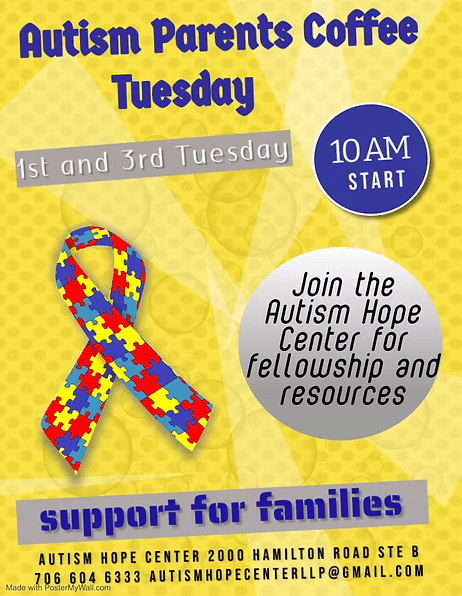
  • Autism Parents Coffee Tuesday

    Recurring
    Autism Hope Center 2000 Hamilton Road Ste B, Columbus, GA, United States

    Join the Autism Hope Center for fellowship and resources. First and third Tuesday of every month.

    Free
  • Support Group for Adults

    Recurring

    This multi-session support group is for Autistic adults (18+) who are post k-12. Through this group, members can build an ongoing connection with a small community. AANE support groups give members an opportunity to celebrate successes and support each other through difficulties. Common topics of discussion are:

    Masking/camouflaging
    Sensory sensitivities/overloads
    Relationships
    Self-care
    Disclosure
    Work/jobs
    Intersectionality

    $100
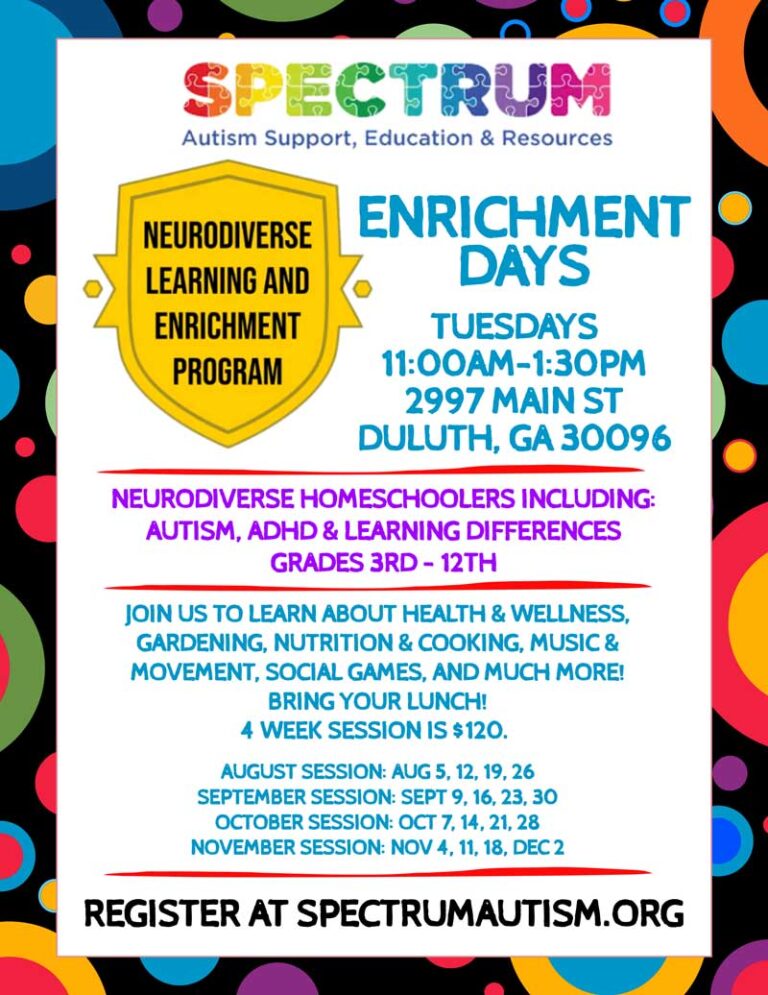
  • Enrichment for Homeschoolers

    Recurring
    Spectrum Autism Support Center 2997 Main St, Duluth, GA, United States

    Spectrum's Homeschool Learning and Enrichment program offers an inclusive and welcoming space for 3rd-12th grade students who are on the autism spectrum, have ADHD, dyslexia, or other learning differences. This program is designed for children with independent self-help skills who require minimal supervision with staff ratios of 1:6.

    The group will meet on Tuesdays, 11 am to 1:30 pm Social skills development with structured peer interactions, group activities, socio-emotional strategies will be offered. We will offer enrichment activities like Arts and Crafts, Music, Gardening and Nature Activities, Executive Function Skills, STEM (task management, time management), Social Skills and Peer Interaction, Life Skills (e.g., cooking, budgeting, organization), and Career Readiness (for teens and young adults). Arts, drama, music, STEM, cooking, gardening, and life skills training. Innovative learning methods will feature activities led by specialists such as drum circle leaders, theatre professionals, Master Gardeners, and yoga instructors. Opportunities to build friendships and strengthen social skills through fun and engaging activities like playing games, outdoor play, and watching movies with peers will be provided after lunch. Students will bring their own lunch.

  • October 2025 Homeschool Enrichment Program

    Recurring
    Spectrum Autism Support Center 2997 Main St, Duluth, GA, United States

    Social skills development with structured peer interactions, group activities, socio-emotional strategies will be offered.
    We will offer enrichment activities like Arts and Crafts, Music, Gardening and Nature Activities, Executive Function Skills, STEM (task management, time management), Social Skills and Peer Interaction, Life Skills (e.g., cooking, budgeting, organization), and Career Readiness (for teens and young adults). Arts, drama, music, STEM, cooking, gardening, and life skills training. Innovative learning methods will feature activities led by specialists such as drum circle leaders, theatre professionals, Master Gardeners, and yoga instructors. Opportunities to build friendships and strengthen social skills through fun and engaging activities like playing games, outdoor play, and watching movies with peers will be provided after lunch. Students will bring their own lunch.

    $120
  • Family Guide to Transition Planning: Preparing Students with Disabilities for Life after High School – Starbridge

    The purpose of the Family Guide to Transition Planning—Preparing Students with Disabilities for Life After High School is to assist families in understanding the transition planning process specifically from high school to life after high school. When families are knowledgeable about the transition process and invited to participate by Educational Organizations (EOs), students with disabilities experience improved post-school outcomes in the areas of employment, postsecondary education, and independent living. Presented by the Mid-West Family & Community Engagement Center.

    Free
  • Tool Time Tuesdays

    Recurring

    10/7/25: Reimagining Support: A New Way to Learn and Transform Lives for Medically Fragile Kids - We will take a look at the new media channel for Advocates for Medically Fragile Kids NC and see how this tool can put more information into the hands of parents. Presented by Jenny Hobbs
    10/14/25: Virtual Meetings 101 - Virtual IEP meetings are occurring more and more frequently. In this webinar, we will explore how to navigate virtual meetings while still maintaining communication and collaboration. Join us for some tips and tricks as well as supporting resources. Presented by Anastacia Newton, Parent Educator
    10/21/25: From Incident to Insight: Actively Participating in a Manifestation Determination Review (MDR) - Your guide to a successful Manifestation Determination Review: prep, participation tips, and ECAC’s MDR Checklist. Presented by Mandy Sonnenberg, PTI Manager
    10/28/25: What is the Prior Written Notice and why does it matter? - Other than the Individualized Education Program (IEP), the Prior Written Notice (PWN) is one of the most important documents in the special education process. We will go through the PWN form and discuss why it is critical to make sure that it is accurate. We will also touch on other places where IEP team decisions are documented. Presented by Doreen Byrd, Lead Parent Educator

    Free
  • What, Wait! You Want Me to Talk About Sexuality?

    Healthy relationship boundaries are an important skill for us all. We are seeing more and more examples of those who have crossed lines in our culture. Even though people with intellectual and developmental disabilities are sexual beings, just like everyone, they also need the information and skills to navigate these waters and learn what's okay and not okay in various settings.

    This webinar will explore tips and tools for addressing sexuality one-on-one with the individuals you work with. We will explore why this topic can be difficult to approach and useful tools that will help you become more comfortable and confident and communicate about this sensitive topic.

    Free
  • Support Group for Parents of LGBTQIA+ Teens & Adults (14+)

    Recurring

    This 8-session AANE support group is designed for parents and caregivers of Autistic (or similarly neurodivergent) teens (age 14+) and adults who also identify as LGBTQIA+. In this small, welcoming group setting, participants will have the opportunity to share experiences, access valuable resources, and build meaningful connections with others navigating similar journeys. Each session offers a supportive space to explore the unique intersections of neurodivergence and LGBTQIA+ identity, while providing guidance, insight, and a sense of community.

    $180
  • Support Group for Women (18+)

    Recurring

    This bi-weekly “closed” support group is designed for autistic and similarly neurodivergent adult women (18+) who are looking to build an ongoing connection with other women. The group is primarily a space to learn about and discuss neurodivergence, and to explore related topics chosen by the group. Topics may include:

    Masking/camouflaging
    Sensory Sensitivities and Sensory Overload
    Relationships
    Self Care
    Empathy

    The group is structured to encourage everyone to share and participate in the discussion, with respect for all members prioritized.

    $100