
EarliPoint Technology and Early Autism Detection
EarliPoint Technology and Early Autism Detection
Identifying autism early can make an big difference in a child’s development. An early identification and diagnosis helps children and families connect with autism-specific therapies, services, and other supports when they are most needed. It can also help families better understand a child’s strengths and needs and learn how to best support their development.
The early years of life are also a time of rapid brain development and learning. Providing appropriate support during this time can help children develop communication skills, social skills, and daily living skills that are essential for daily life. Children who receive the right support early tend to have better developmental outcomes than children who have to wait for those services. Therefore, finding reliable ways to identify autism at younger ages can help children access services sooner and ultimately learn life skills more quickly.
One promising approach for identifying behaviors associated with autism is the use of biomarkers. Biomarkers are measurable biological or behavioral signals that may help identify a condition. Researchers are studying whether biomarkers can help make autism identification more accurate and allow children who may be autistic to be identified and evaluated earlier.
What is a Biomarker?
A biomarker, or biological marker, is a measurable indicator of a biological process that can help predict a disease or health outcome. Biomarkers are objective and quantifiable characteristics of the body – put another way, biomarkers are measurable things in the body that can provide information about how the body is working. For example, blood glucose levels are used as a biomarker for diabetes, while cholesterol levels can indicate an increased risk for heart disease. Biomarkers are valuable because they can support earlier detection and more accurate diagnosis of medical conditions.
Eye Tracking as a Biomarker for Autism:
Difficulty with social interaction is a core characteristic of autism. Autistic individuals may have challenges recognizing other people’s emotions or understanding how to respond in social situations. One well-studied biomarker related to autism involves patterns of visual attention during social interactions. For example, autistic individuals may spend less time looking at another person’s eyes or face and more time focusing on background objects or other details in the environment. Because these differences in gaze patterns have been extensively studied, tracking a child’s eye movements act as a useful biomarker for autism and be used as part of an autism evaluation.
To see how gaze patterns can be used as a biomarker of autism, consider the image below. The picture shows two boys interacting. A child with autism will likely direct their attention to different parts of the image than a child without autism. The column on the left shows scenes from the video itself. The middle column shows where a child without autism looked while watching the video. This column includes a “heat map,” in which darker red areas indicate where the child spent the most time looking. It also includes a shaded image of the video, where the more colorful areas highlight the parts of the scene that received the most visual attention. The child without autism focused primarily on the boys’ faces and their hand gestures during the interaction.
The column on the right shows where a child with autism was looking while watching the same video. The autistic child spent more time looking at toys and object in the background than on the people in the scene.

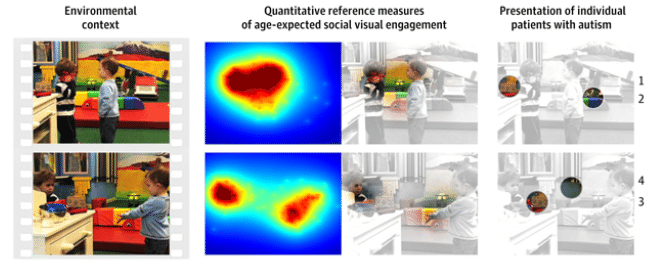
When researchers looked at how the two children watched the video, they found an important difference. The child without autism spent most of their time looking at the boys in the video and other things that helped them understand what the boys were doing and feeling. In contrast, the autistic child spent more time looking at things in the background that were not related to the boys or what they were doing.
Autism Diagnosis
Autism can often be reliably diagnosed in children between 18 and 24 months of age. However, according to the Centers for Disease Control and Prevention, early signs of autism may appear even earlier in development. Some behaviors associated with autism, such as reduced eye contact, make eye-tracking technology a promising tool for early detection. Early identification is important because it allows children to access interventions and support services as soon as possible.
What is EarliPoint?
EarliPoint Health developed EarliPoint devices to help detect autism. EarliPoint works by measuring what children pay attention to while watching video clips of other children playing together. As you can see in the image below, EarliPoint devices look like a tablet set into a metal stand. What you may not be able to see in the image is the array of tiny pinhole cameras that surround the tablet and track where a child is looking.
During an EarliPoint assessment, children watch video clips on the tablet while the pinhole cameras around track the child’s eye movements. In that way, EarliPoint collects information about which parts of the scenes capture the child’s attention as they watch the video. During this part of the assessment, EarliPoint collects a lot of data about where a child is looking – it collects 120 snapshots per second (7200 snapshots per minute!)! That means that an EarliPoint assessment collects a lot of data for each child tested.
When the EarliPoint assessment is completed, the collected data are sent to EarliPoint Health for analysis. Based on the results, the company generates a report indicating the likelihood that the child may have autism. The child’s physician can then use that information to diagnose the child with autism or not. Below is an image of an EarliPoint device.

You can watch a short video to better understand EarliPoint here: https://youtu.be/zKEcAimzEN8
How can EarliPoint help you?
Mercer University School of Medicine is helping improve access to autism screening for rural families through a pilot program using EarliPoint technology. EarliPoint offers several advantages for families living in rural communities, where access to specialized autism evaluations may be limited. Research suggests that EarliPoint’s accuracy is comparable to traditional autism assessment methods, while also being less expensive.
Wait times for EarliPoint testing through our pilot program are currently under 1 month, which is considerably shorter than the wait times for traditional testing (which are often over one year long!). In many cases, testing can be completed directly within a child’s local physician’s clinic, reducing the need for long-distance travel to specialty centers. This can help children receive evaluations and support services sooner. Of note, Georgia Medicaid accepts autism diagnoses made using EarliPoint for the purposes of helping a child access early intervention services! Which means that EarliPoint can help children receive early intervention much sooner than might otherwise be possible.
Mercer’s pilot program currently includes EarliPoint testing sites in Washington, Laurens, Berrien, Towns, Glynn, Jones, Coffee, and Ware counties, expanding access to early autism detection across rural Georgia. If you would like to learn more about Mercer’s pilot program or receive additional information about EarliPoint, please contact the program at asd@mercer.edu.
Fast Facts:
- EarliPoint correctly identifies 4 out of 5 children with autism.
- EarliPoint is an FDA Authorized* tool for ages 16-96 months. *FDA Authorized means that EarliPoint has been granted permission to help clinicians evaluate autism based on current evidence (meaning it can be used now based on promising results). However, it is not yet FDA approved, which requires further clinical data.
- EarliPoint can be performed in outpatient pediatric offices.
- EarliPoint’s accuracy is comparable to traditional testing like ADOS test.
- Georgia Medicaid will cover autism testing using EarliPoint.
Article by: Isabella Valentini and The Autism Toolkit
Sources:
https://jamanetwork.com/journals/jamanetworkopen/fullarticle/2808909
National Libraries of Medicine Sources:
https://pmc.ncbi.nlm.nih.gov/articles/PMC3078627/
https://pmc.ncbi.nlm.nih.gov/articles/PMC4035120/
https://pmc.ncbi.nlm.nih.gov/articles/PMC2758571/
https://pmc.ncbi.nlm.nih.gov/articles/PMC10491411/
Other resources you may be interested in
Please enjoy our articles and contact us if there’s a topic you would like more information about.