
Understanding Autism, ADHD, and AuDHD
Understanding Autism, ADHD, and AuDHD
Many people have heard of autism and attention-deficit/hyperactivity disorder (ADHD), but fewer know that someone can have both conditions at the same time. This combination is sometimes called AuDHD. Although AuDHD is not an official medical diagnosis, it is a commonly used term within the autism and ADHD communities to describe people who meet the diagnostic criteria for both autism and ADHD.
Because autism and ADHD share some similarities, it can sometimes be difficult to recognize when both conditions are present. If you are hearing these terms for the first time, you’re not alone. Learning about autism, ADHD, and AuDHD can feel overwhelming, but understanding how they relate to one another can help families find the right supports and services.
What is Autism?
Autism, or Autism Spectrum Disorder (ASD), is a lifelong developmental difference that affects how a person communicates, learns, experiences the world, and interacts with others. Autism can affect communication, social interactions, learning, behavior, and how someone experiences sights, sounds, textures, smells, or other sensory information. Because autism is a spectrum, every autistic person is unique and has their own combination of strengths, challenges, and support needs.
Some autistic individuals may communicate verbally, while others may use alternative forms of communication. Many autistic people have strong interests in specific topics, prefer routines, or experience differences in how they process sights, sounds, textures, or other sensory information. These characteristics can vary greatly from person to person.
Autism is not an illness and does not have a single presentation. With appropriate supports, autistic individuals can thrive at home, in school, at work, and within their communities.
What is ADHD?
Attention-Deficit/Hyperactivity Disorder (ADHD) is another neurodevelopmental condition that affects attention, impulse control, activity level, and executive functioning skills, such as organization, planning, and time management. ADHD is one of the most common developmental conditions diagnosed during childhood, although many people are not diagnosed until adolescence or adulthood.
Not everyone with ADHD is hyperactive. Some people primarily have difficulty paying attention, while others experience more hyperactivity and impulsivity. ADHD is generally categorized into three presentations:
- Predominantly Inattentive Presentation: difficulty sustaining attention, following directions, staying organized, or remembering daily tasks.
- Predominantly Hyperactive-Impulsive Presentation: frequent fidgeting, excessive movement, difficulty waiting, or acting without thinking.
- Combined Presentation: a combination of inattentive and hyperactive-impulsive symptoms.
Many individuals with ADHD also experience difficulties with emotional regulation.
They may feel emotions more intensely, become frustrated more quickly, or have difficulty managing strong emotional responses. Although emotional regulation challenges are not part of the formal diagnostic criteria for ADHD, research has shown they are a common part of the lived experience for many individuals with ADHD. Like autism, ADHD exists on a spectrum of experiences. Symptoms and support needs vary from person to person, and many individuals with ADHD develop effective strategies to help them succeed in school, work, and everyday life.
Can Someone Have Both?
Although autism and ADHD are separate neurodevelopmental conditions, they can occur together. Both conditions have strong genetic influences and often run in families. Before 2013, clinicians generally could not diagnose both conditions together. Today, research shows autism and ADHD commonly occur together. Many autistic individuals also meet the diagnostic criteria for ADHD, and some individuals with ADHD may also be diagnosed with autism. Because autism and ADHD share some characteristics, it can sometimes be difficult to recognize when both are present. Some traits overlap, while others may hide each other. As a result, many people are first diagnosed with only one condition before later learning they meet the criteria for both.
What Does AuDHD Look Like?
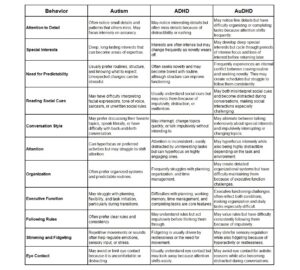
People with AuDHD (both autism and ADHD) often experience a combination of traits from both conditions. Because autism and ADHD can influence each other, the presentation is not simply “autism plus ADHD.” Some traits may reinforce each other, while others may seem to conflict. Every person with AuDHD is different, and support needs can vary widely.
To see how AuDHD can look, the table below breaks down how certain behaviors may manifest in autism, ADHD, and AuDHD.
Why Can AuDHD Be Difficult to Recognize?
Some autism traits and ADHD traits can overlap, while others can hide each other. This is one reason many people are diagnosed with one condition before the other.
Some individuals also learn to “mask,” meaning they consciously or unconsciously hide certain behaviors to fit in with others. For example, a child may work very hard to copy classmates during social situations or hide behaviors that make them feel different (like stimming). Although masking may help someone blend in, it can also be mentally exhausting and may contribute to stress, anxiety, or burnout over time. Girls, women, and people from different cultural backgrounds are sometimes diagnosed later because their traits may look different or be easier to overlook.
How is AuDHD Diagnosed?
There is no separate test for AuDHD. AuDHD is when someone meets the diagnostic criteria for autism AND meet the criteria for ADHD. To make those diagnoses, clinicians will consider a person’s:
- Developmental History: Did the person meet all of their developmental milestones on time?
- Social Development: Can the person make friends? Do they respond to another person during conversation?
- Play Skills: Did the person use their imagination when they played as a child? Did they play with the toys as intended or focus on just one aspect of the toy? Did they play with others?
- School Performance: Did the person show restlessness or inattention at school? Did teachers notice any unusual behaviors?
- Sensory Sensitivities: Did / does the person have unusually large responses to sensory input? Unusually small responses?
- Family History: Does anyone else in the person’s family have autism or ADHD?
By: Savannah Pollock and The Autism ToolKit
Sources
CDC – Autism Spectrum Disorder. https://www.cdc.gov/autism/index.html
CDC – ADHD. https://www.cdc.gov/adhd/index.html
Autism Speaks – Autism and ADHD. https://www.autismspeaks.org/audhd
National Libraries of Medicine Sources
Antshel, K. M., & Russo, N. (2019). Autism Spectrum Disorders and ADHD: Overlapping Phenomenology, Diagnostic Issues, and Treatment Considerations. Current psychiatry reports, 21(5), 34. https://doi.org/10.1007/s11920-019-1020-5
Leitner Y. (2014). The co-occurrence of autism and attention deficit hyperactivity disorder in children – what do we know?. Frontiers in human neuroscience, 8, 268. https://doi.org/10.3389/fnhum.2014.00268
MedlinePlus – Autism Spectrum Disorder. https://medlineplus.gov/autismspectrumdisorder.html
MedlinePlus – Attention-Deficit/Hyperactivity Disorder (ADHD). https://medlineplus.gov/attentiondeficithyperactivitydisorder.html
National Libraries of Medicine Resources
If you’d like to learn more about autism and ADHD, take a look at the MedlinePlus articles below!
MedlinePlus – Autism Spectrum Disorder. https://medlineplus.gov/autismspectrumdisorder.html
MedlinePlus – Attention-Deficit/Hyperactivity Disorder (ADHD). https://medlineplus.gov/attentiondeficithyperactivitydisorder.html
Other resources you may be interested in
Please enjoy our articles and contact us if there’s a topic you would like more information about.